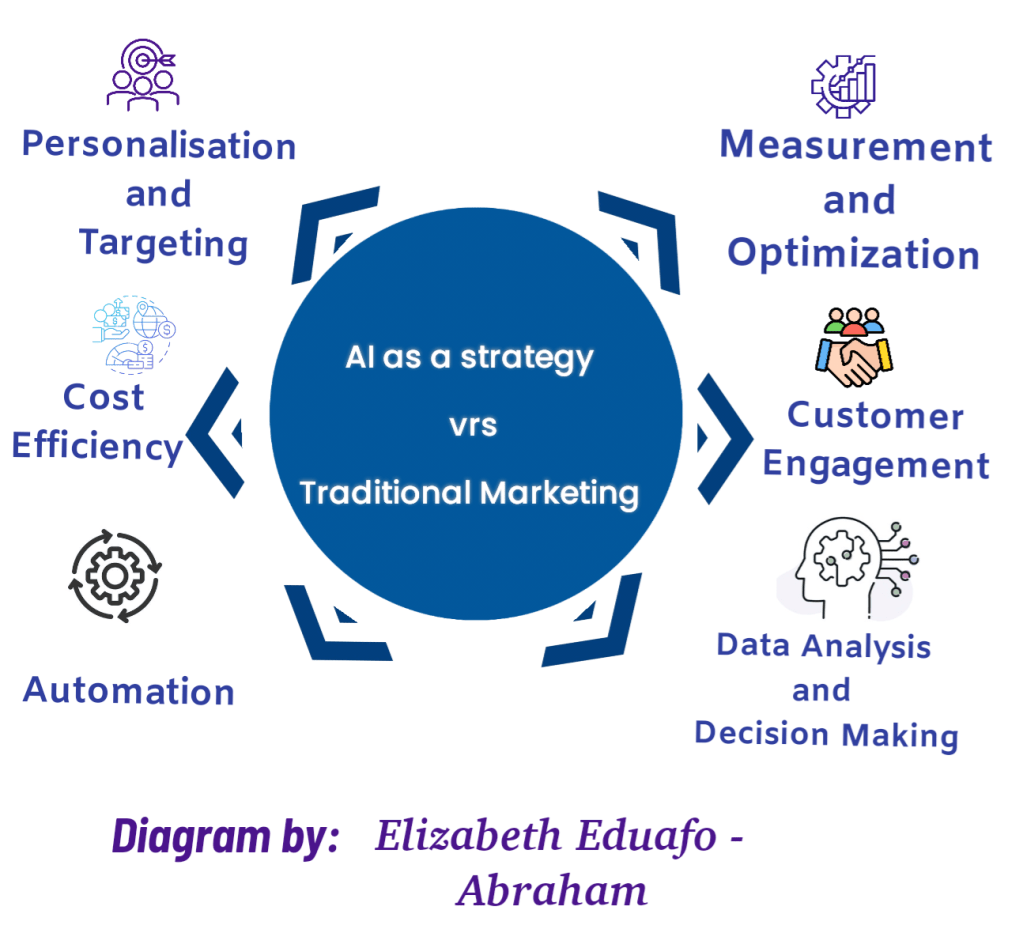
AI as a Strategy to Marketing vs. Traditional Marketing
1. Personalization and Targeting
AI Marketing: AI-driven tools analyze customer behaviour, preferences, and demographics to deliver highly personalized and targeted marketing messages. This helps marketers reach specific audiences with relevant content, improving engagement and conversions.
Traditional Marketing: Traditional marketing often relies on broader approaches like TV, radio, and print ads that target larger, less segmented audiences. Personalization is limited, making it less effective for precise targeting.
2. Data Analysis and Decision-Making
AI Marketing: AI can process vast amounts of data quickly, offering insights into customer behaviour, trends, and campaign performance in real time. Marketers can make data-driven decisions, optimizing their strategies on the fly.
Traditional Marketing: Traditional marketing relies on manual data collection and analysis, which can be slow and less accurate. Decisions are often based on historical data and intuition, limiting the ability to adapt quickly to changes.
3. Automation
AI Marketing: AI automates repetitive tasks such as sending emails, managing social media, and handling customer service through chatbots. This allows marketers to focus on strategic activities and improve efficiency.
Traditional Marketing: Automation in traditional marketing is limited. Processes like manual campaign execution and customer service handling take more time and resources.
4. Cost Efficiency
AI Marketing: AI tools can reduce costs by automating tasks, optimizing campaigns, and reducing waste from poorly targeted ads. AI also enables more precise budgeting by focusing efforts on high-value customers.
Traditional Marketing: Traditional marketing methods like print ads, billboards, and TV/radio spots can be expensive and often lack clear ROI metrics, making them less cost-effective.
5. Customer Engagement
AI Marketing: AI enables real-time, personalized customer interactions through chatbots, recommendation engines, and tailored content. This enhances engagement and builds stronger customer relationships.
Traditional Marketing: Engagement in traditional marketing is mostly one-way, with brands broadcasting messages to audiences. Interaction is limited, making it harder to maintain customer interest and loyalty.
6. Measurement and Optimization
AI Marketing: AI can continuously monitor campaign performance, providing insights for optimization. It allows for A/B testing, predicting trends, and adjusting strategies based on real-time data.
Traditional Marketing: Measuring the effectiveness of traditional marketing campaigns is more difficult. Results are often tracked through sales or brand awareness over time, with fewer real-time optimization opportunities.
Conclusion: AI as a strategy in marketing offers more personalization, real-time data analysis, automation, cost efficiency, and engagement opportunities compared to traditional marketing. While traditional methods still have value, especially for brand awareness and mass outreach, AI-driven marketing is increasingly becoming the preferred approach for businesses aiming to stay competitive and adapt to consumer behaviours.
 Marketing Insight.